

Material Information
The Group updates the information in the Market Observation Post System from time to time for investors to make enquiries, click 《Material Information and Announcement》 and click 《Material Information》 to select the desired item, and then enter the code number of TEWC《1623》to make an inquiry.
Corporate Governance

Board of Directors
The Board of Directors is the highest governing body of the Company and the center of major business decisions. Its responsibilities include appointing and supervising the Company’s management, overseeing business performance, preventing conflicts of interest, ensuring that the Company exercises its authority in accordance with various laws and regulations, the Company’s Articles of Incorporation, or shareholders’ meeting resolutions, and endeavoring to maximize the rights and interests of shareholders.
The Board of Directors of the Company consists of 7 directors, including 3 independent directors, and there are currently 3 female directors, with a ratio of 42.86%.
No more than half of the directors are related to each other by spouse or consanguineous within two degrees, etc., and there are no circumstances stipulated in Article 26-3, Paragraph 3 and Paragraph 4 of the Securities and Exchange Act.
Duties of the Board of Directors
1.Resolutions on important matters and various operations of the corporate governance system.
2.Overseeing the Company and its management in respect of the rule of law, financial matters and disclosure of material information, etc.
3.Evaluating the performance of the management team and appointing and removing managers.
4.Guiding the management team in formulating the company’s strategy and constantly reviewing the progress of the strategy and making appropriate adjustments.
5.Ensure that the Board of Directors exercises its powers and functions in accordance with the laws and regulations, the Company’s Articles of Incorporation, or the resolutions of the shareholders’ meetings.
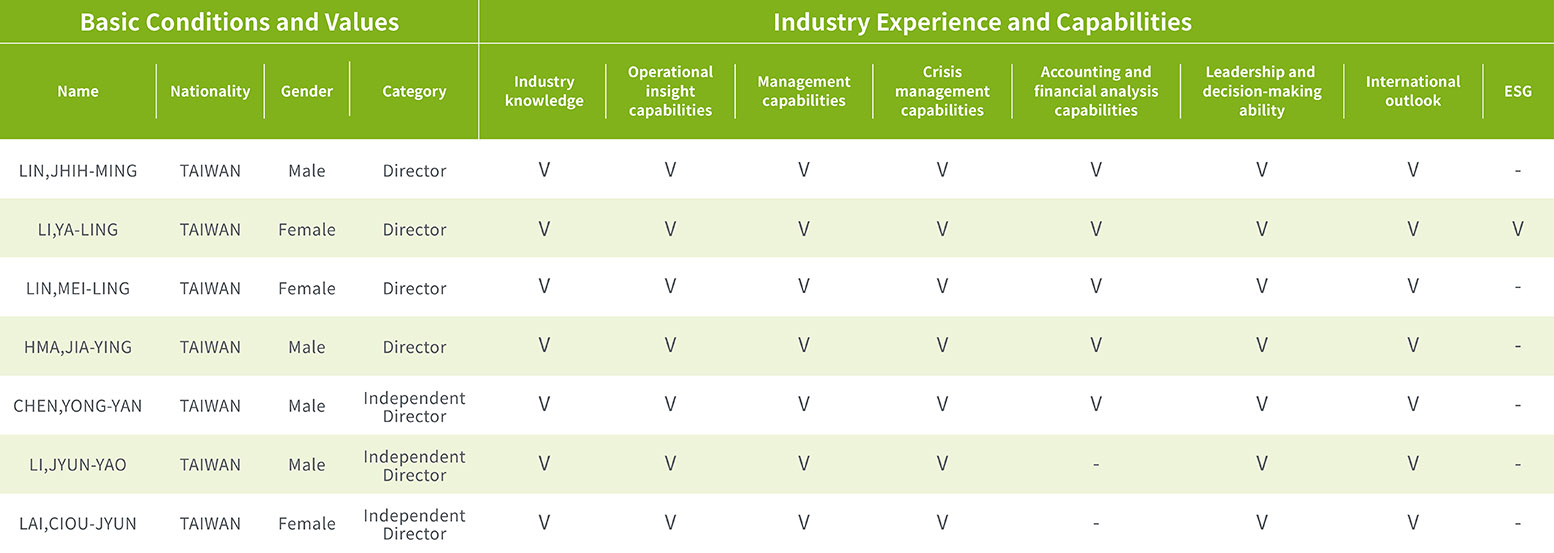
Board members should generally possess the knowledge, skills, and qualities necessary to perform their duties. Their overall capabilities are as follows:
1. Operational judgement.
2. Accounting and financial analysis skills.
3. Business management skills.
4. Crisis management skills.
5. Industry knowledge.
6. International market perspective.
7. Leadership skills.
8. Decision-making skills.
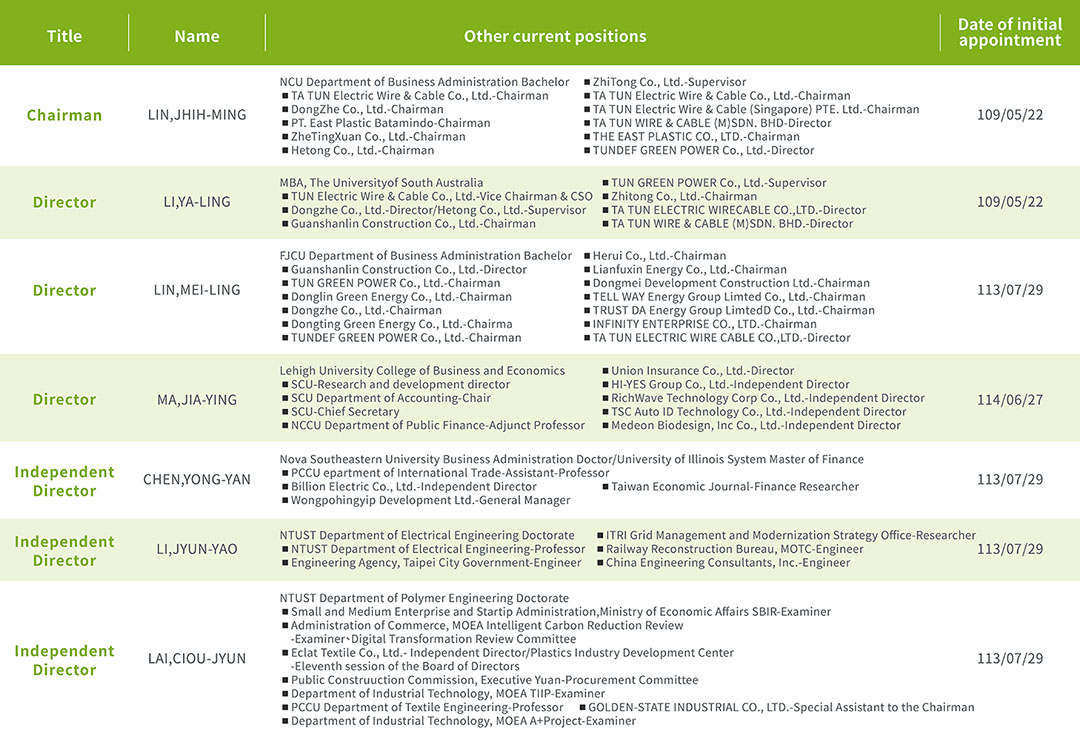
Board Members
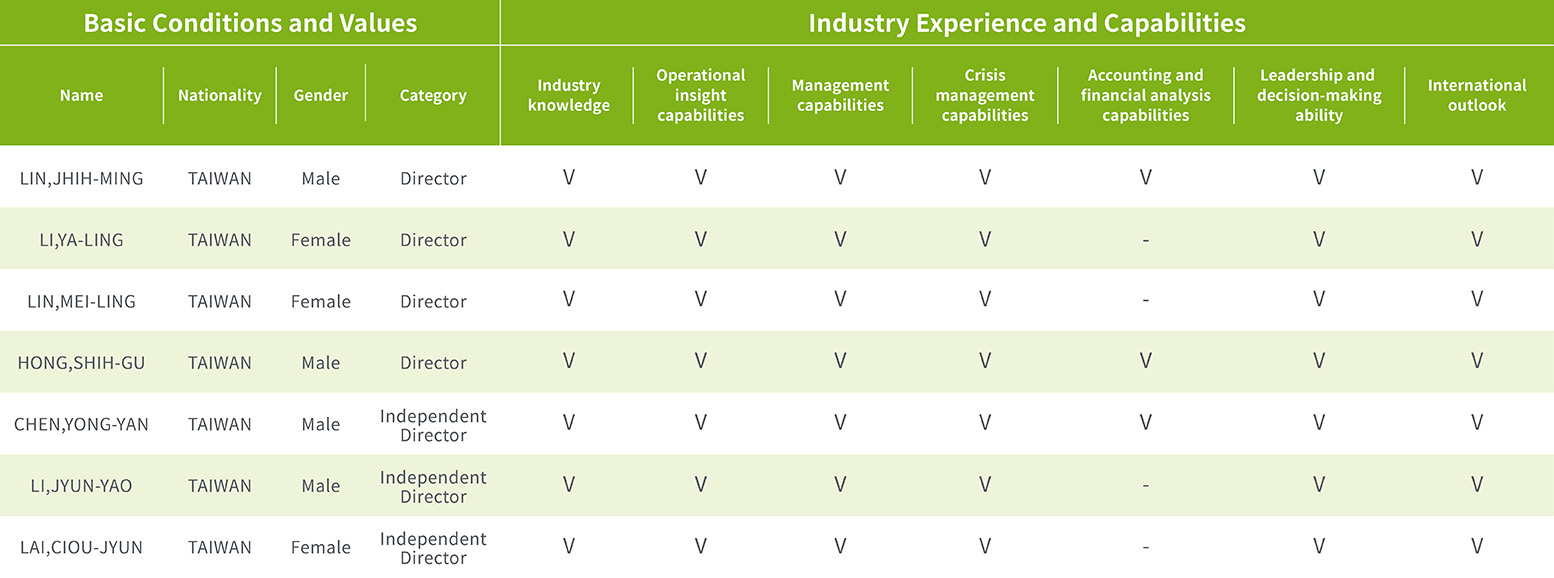
Diversity and Independence of the Board of Directors
The professional qualifications and selection criteria of the Company’s directors are in compliance with the Company Law, and the Company has established the “Procedures for Selection of Directors”, which stipulates that the selection of directors should take into account the overall configuration of the Board of Directors, and the composition of the Board of Directors should take into account the diversity of the Board of Directors, except that more than one-half of the seats among the directors should be reserved for each director, and that there should be no relatives within the meaning of spouses or second-degree relatives. The Board of Directors should also draw up appropriate diversification policies with respect to its operation, business style and development needs, including the following But not limited to the following two criteria:
1.Professional knowledge and skills: professional background (e.g. law, finance, accounting, industry, marketing and technology), professional skills and industry experience, etc.
2.Basic conditions and values: gender, age, nationality, culture, etc.
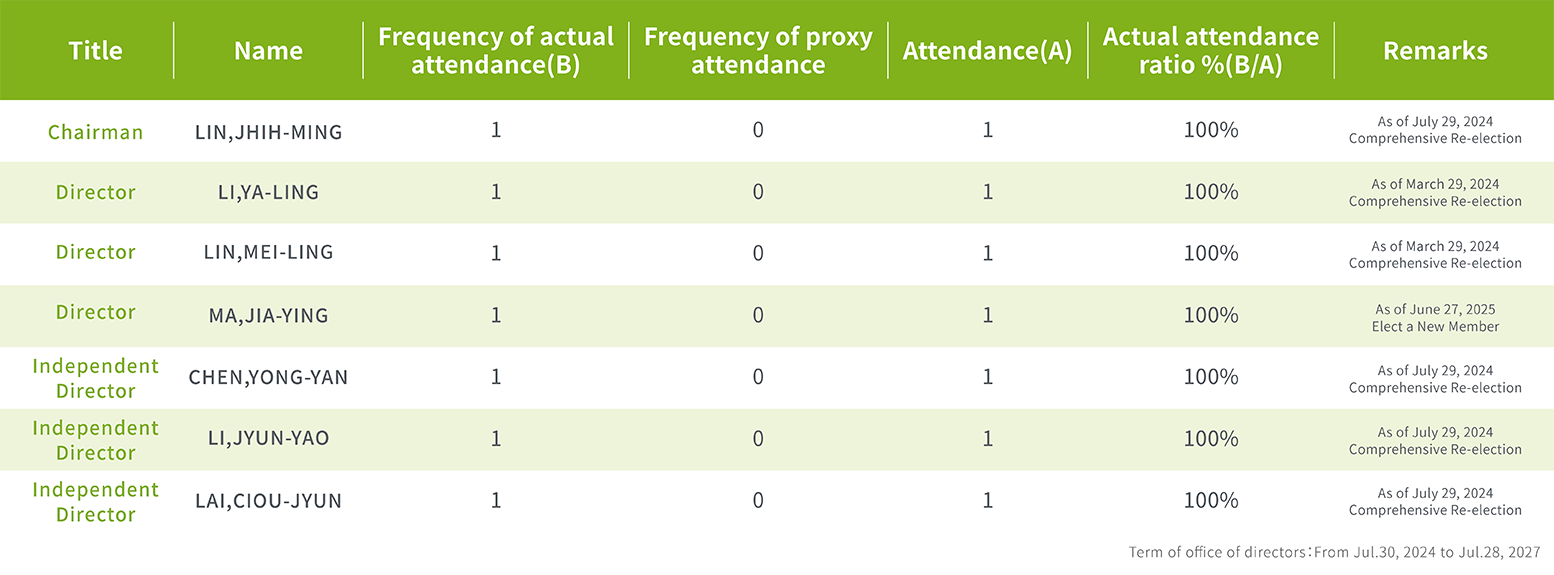
Annual Board Operation Information
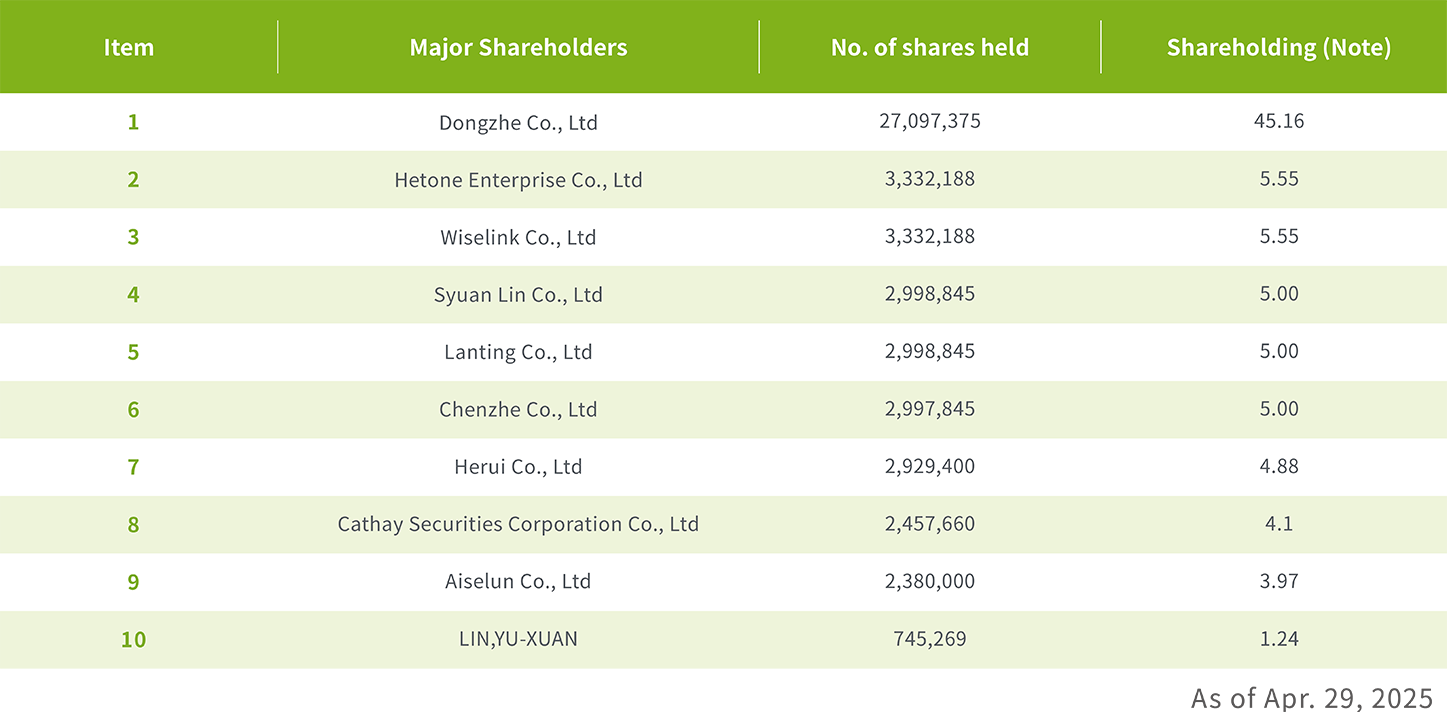
Top 10 Major Shareholders
Audit Committee
The Company has established an Audit Committee in 2024, which shall perform the following duties and submit its recommendations to the Board of Directors for discussion.
Responsibilities and Key Focus Areas for the Current Fiscal Year ❰ The Audit Committee meets at least once a quarter ❱
1.Establishment or revision of internal control systems and assessment of the effectiveness of internal control systems in accordance with Article 14-1 of the Securities and Exchange Act.。
2.In accordance with Article 36-1 of the Securities and Exchange Act, establish or revise procedures for handling major financial and business activities such as the acquisition or disposal of assets, engaging in derivative transactions, lending funds to others, endorsing for others, or providing guarantees.
3.Matters involving the personal interests of directors.
4.Significant asset or derivative transactions.
5.Significant loans, endorsements, or guarantees.
6.The raising, issuance, or private placement of securities with equity characteristics.
7.Appointment, dismissal, or remuneration of certified public accountants.
8.Appointment and dismissal of financial, accounting, or internal audit managers.
9.Annual financial reports and semi-annual financial reports.
10.Other significant matters specified by other companies or competent authorities.
The Board of Directors is the highest governing body of the Company and the center of major business decisions. Its responsibilities include appointing and supervising the Company’s management, overseeing business performance, preventing conflicts of interest, ensuring that the Company exercises its authority in accordance with various laws and regulations, the Company’s Articles of Incorporation, or shareholders’ meeting resolutions, and endeavoring to maximize the rights and interests of shareholders.
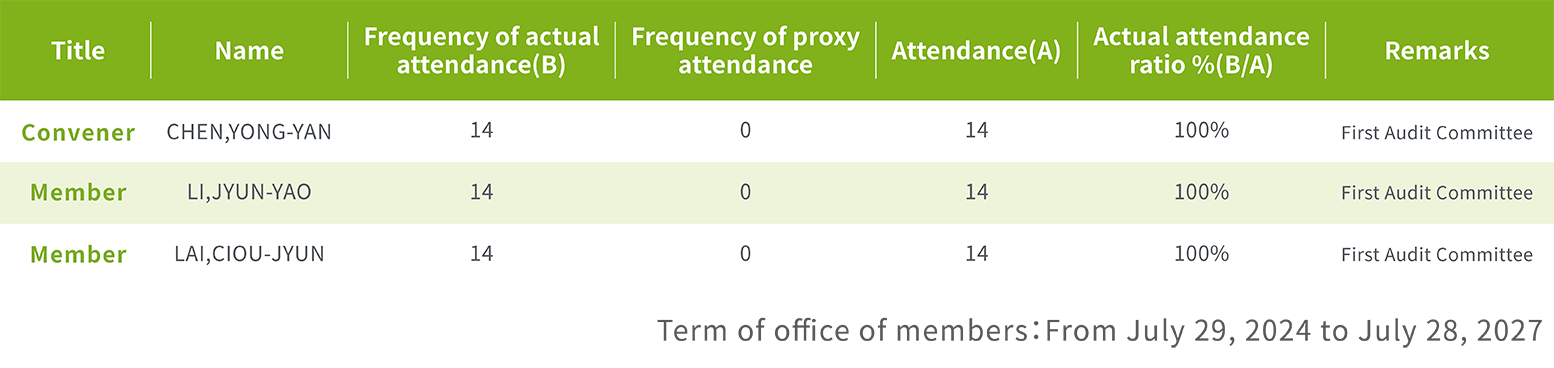
Audit Committee Operation Status
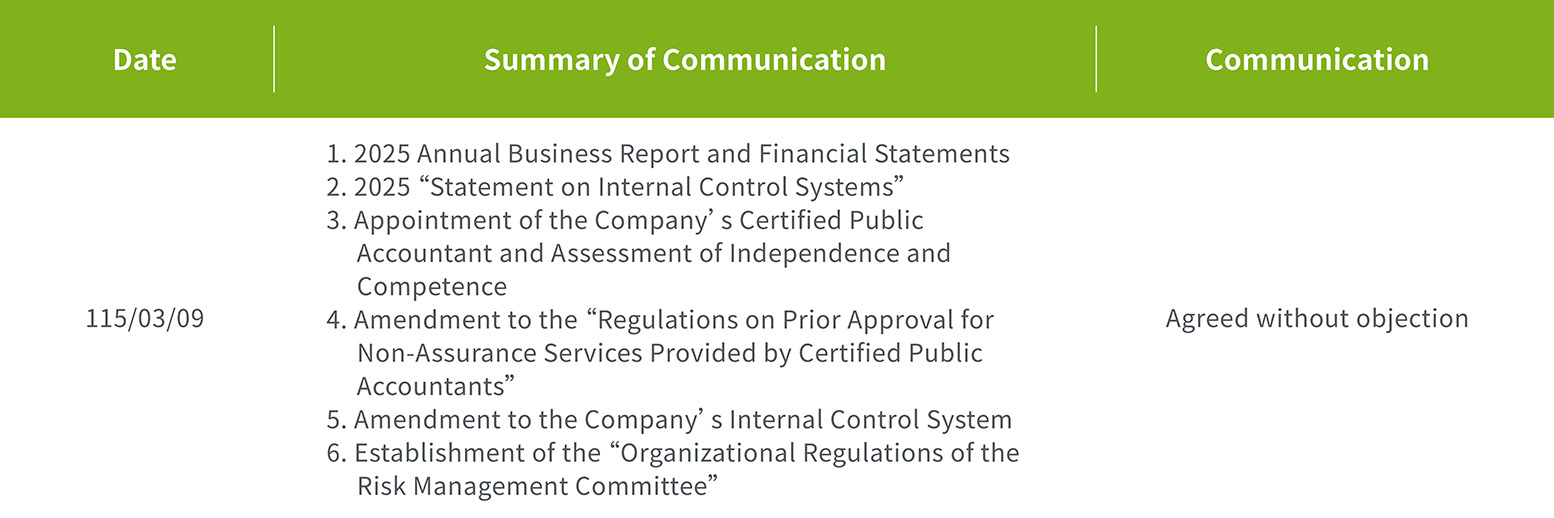
The Communication Between Independent Directors, Internal Auditor and The Certified Accountants
1.Policy on Communication between Independent Directors and the Head of Internal Audit and Accountant – At least once a year, a meeting is held between the accountant and the head of audit to discuss the completed external audit opinions of the head of internal audit and the accountant, as well as communication based on the audit deficiencies of the year, and the communication opinions are recorded and submitted to the Board of Directors for report. In the event of material irregularities or matters that the independent directors, the head of audit and the accountants deem it necessary to communicate independently, a meeting may be convened at any time from time to time to communicate with them.
2.Communication in 2026
Compensation Committee
The “Compensation Committee” of the Company is responsible for formulating and reviewing the policies, systems, standards and structures for evaluating the performance and compensation of the Company’s directors and managers as well as their remuneration, and submitting its recommendations to the Board of Directors for discussion. The Compensation Committee meets at least twice a year.
Responsibilities and Key Focus Areas for the Current Fiscal Year
1. Assist the board of directors in implementing and evaluating the company’s overall compensation and benefits policies.
2. In accordance with its organisational regulations, the Compensation Committee shall regularly review the policies, systems, standards, and structures related to the performance and compensation of directors and managers.
3. Regularly evaluate the compensation of directors and managers, make recommendations, and submit them to the board of directors for discussion.
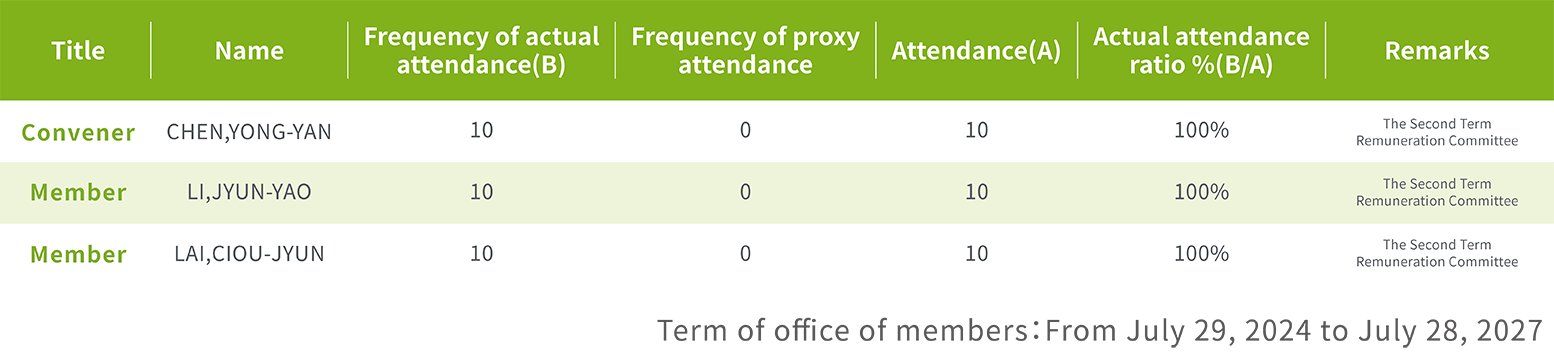
Audit Committee Operation Status
Sustainable Development Committee
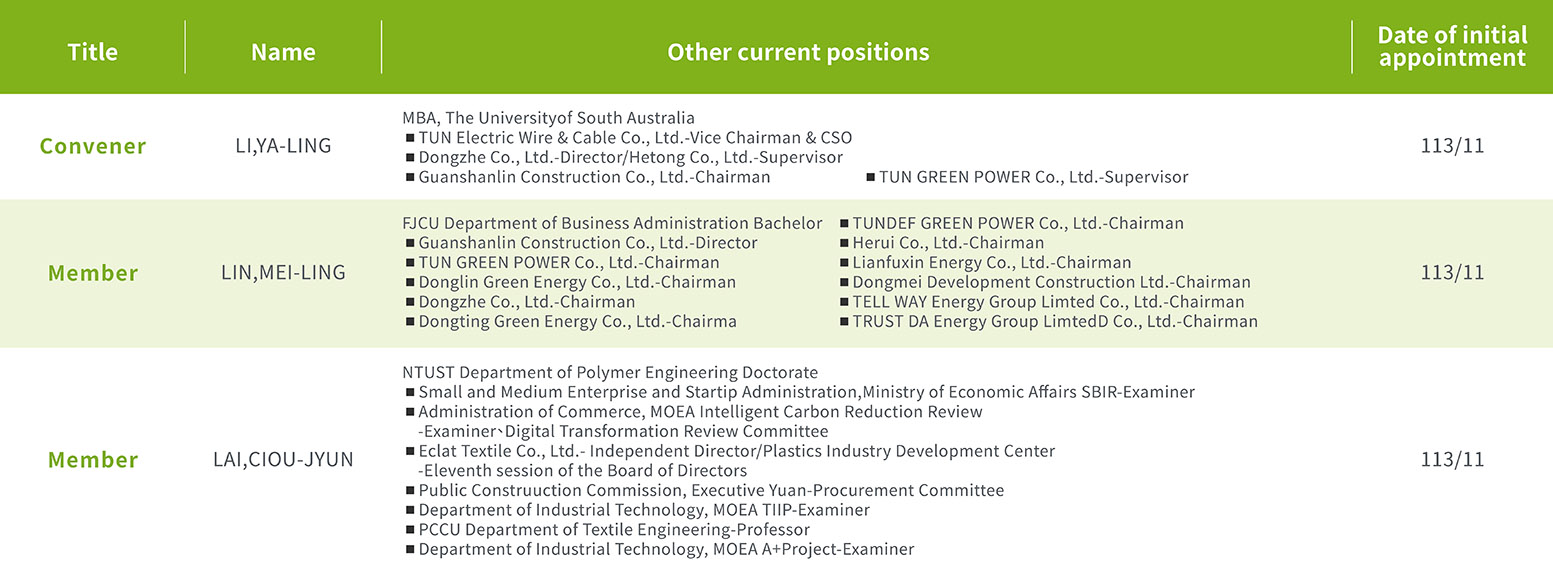
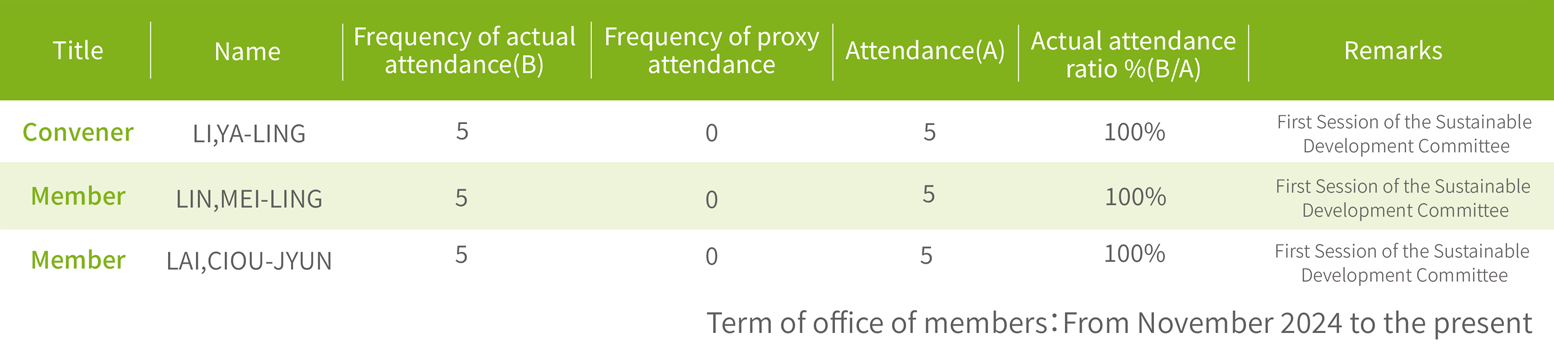
In line with the vision and mission of the ESG policy, the Company has established a Sustainable Development Committee, chaired by Mr. LI,YA-LING, the Chairman of which is responsible for the formulation of relevant policies and the formulation of relevant management policies. The Committee plans and executes sustainable development matters in each of the three major areas, namely, the environmental area, the social area, and the corporate governance area, and reports on the status of the execution of such matters to the Board of Directors on a regular basis every year.
Sustainable Development Committee Members
Information on the Operations of the Sustainability Committee
Terms of Reference and Focus of Work
In order to assist the Board of Directors to continuously promote corporate social responsibility and enhance corporate governance for the purpose of practicing sustainable management, the terms of reference of this Committee shall include the following matters:
1.Formulate the direction (Environmental, Social and Governance) and objectives of corporate social responsibility and sustainable development, as well as draw up relevant management policies and specific promotion plans.
2.Tracking, reviewing and revising the implementation and effectiveness of corporate sustainability.
3.Other matters to be dealt with by the Committee as resolved by the Board.
Information Security
To strengthen and enhance information security management in the future, we have established a dedicated information security organization, formulated information security policies, planned, coordinated and implemented information security protection measures, introduced an information security management mechanism, continued to promote information security management and solutions on a yearly basis through the PDCA cycle of operations and regular implementation of employee education and training on information security, and implemented information security risk assessment and management, and in 2024, we will No information security incident affecting the Company’s business and operation has occurred.
Information Security Policy and Organization
In order to reduce the risk of information security incidents and disruption of business activities, and to protect the business process from information system failure, we focus on compliance with laws and regulations, processes and systems, personnel training, and the use of technology to strengthen the security and protection capabilities of data, information systems, equipment, and networks, and to reduce the risk of data theft, misuse, leakage, tampering, or destruction due to human negligence, intentionality, or natural disasters to achieve the following objectives ensure the continuous operation of the Company’s business.
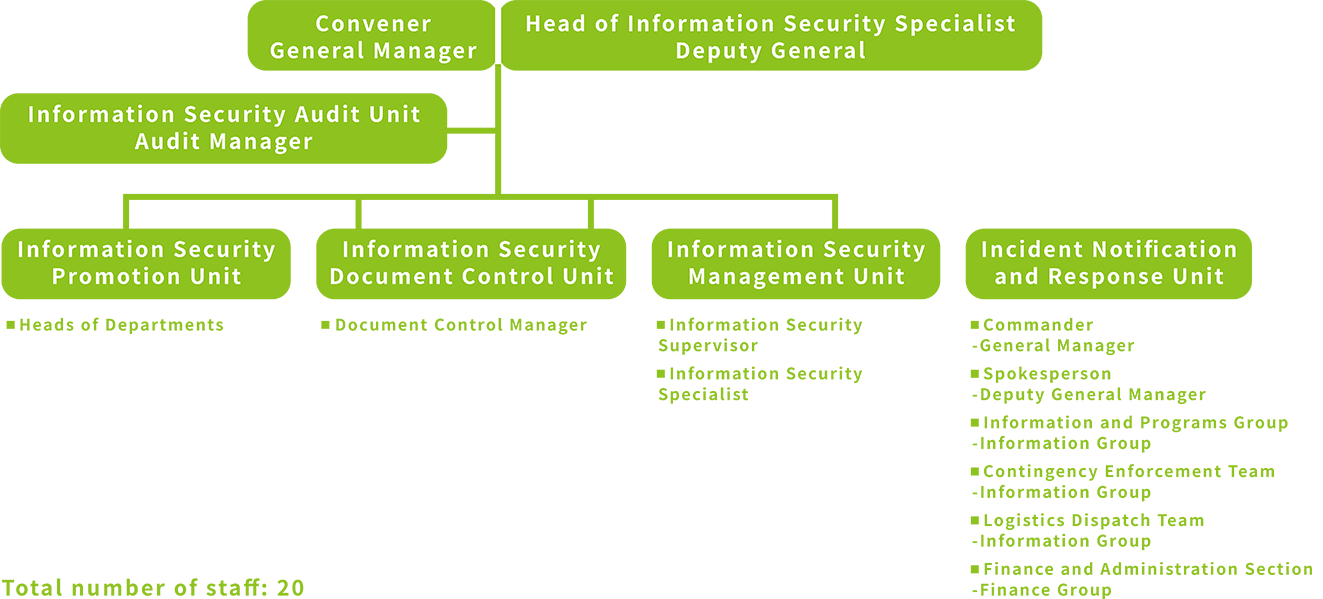
The Information Security Management Committee was established to supervise the implementation of the Company’s information security management system, technology and maintenance operations. The General Manager is the convenor, and the Vice President is the head of information security and the head of the specialized unit. The committee establishes the “Information Security Policy” as the basis for management to protect the security of information and data assets of employees, customers, and suppliers, and to ensure the sustainable operation of the enterprise.
1.Information Security
In order to protect the information of the Company’s products and services from unauthorized access, modification, disclosure of use, and loss caused by natural disasters, we are committed to information security management to ensure the confidentiality, integrity, and usability of the Company’s important information properties and to comply with the requirements of relevant laws and regulations to ensure the continuous operation of the Company’s important businesses.
2.Organizational Structure- Information Security Management Committee
Information Security Management Projects and Implementation Results
1.Establishment of organization and corporate policy – Establishment of “Information Security Management Committee” and formulation of information security policy/information security objective.
2.Staffing of Security Specialists – Staffing of Security Specialists and Security Technicians.
3.Internal Information Security Audit – Perform annual internal information security and personal data security audits for continuous improvement.
4.Network Firewall Protection – Deploy next-generation firewalls and enable advanced persistent threat attack detection and network segmentation to control access rights.
5.Intrusion Detection and Defense – Deploy next-generation intrusion detection and defense to initiate advanced persistent attacks.
6.Enhanced Endpoint Protection – Integrated endpoint protection software protects against malware and ransomware attacks.
7.Email Filtering – Enable Email Filtering/Isolation.
8.Penetration Testing – Perform penetration testing of core systems once a year and continuously remediate vulnerabilities.
9.Vulnerability Scanning – Perform an annual vulnerability scan of the core system and continuously remediate vulnerabilities.
10.Built-in MDR – Imported into the core system MDR mechanism, continuous 24-hour monitoring without interruption.
11.Enhance the backup mechanism – implement the backup 321+1 mechanism.
12. Social Engineering Exercise – conduct a social engineering exercise once a year to enhance employee safety awareness.
13.Employee Safety Education and Training – Annual employee safety education and training to promote information security and enhance employee safety awareness.
14. Disaster Recovery Exercise – Annual scheduling of core system disaster recovery exercise to ensure quick recovery and uninterrupted operation.
15.Join the Intelligence Security Organization – Join the Intelligence Security Organization (TWCERT/CC) and enhance your intelligence defense capabilities.
16.Establishment of a notification mechanism for information security incidents – standardized procedures for handling information security incidents have been established, and relevant processes and measures have been clearly defined.
17.Information Security Incident Status – No Information Security Incident in 2024.
18.Enhanced Cloud Information Security Management – ESG Digital Sustainability through Cloud Services.
Purpose of Internal Audit
1.To assist the Board of Directors or management in examining and reviewing the deficiencies of the internal control system, and to provide timely recommendations for improvement to ensure the continuous and effective implementation of the internal control system and to serve as a basis for reviewing and amending the internal control system.
2.Ensure that the Company’s programs or policies are understood and implemented by all departments, and verify that operations comply with applicable laws and regulations and achieve the Company’s objectives.
3.Enforcement of departmental rules and regulations as the basis for good management and operation.
4.Safeguard the company’s assets against waste, fraud and inefficient use.
Internal Audit
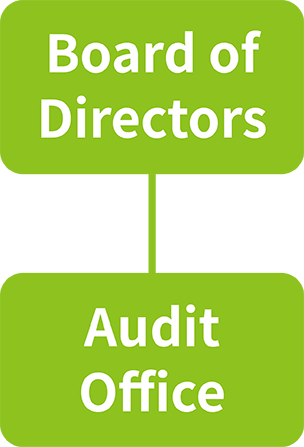
The internal audit unit of the Company is subordinate to the Board of Directors, with a head of internal audit and a number of full-time internal auditors who act as agents for each other. The appointment and removal of the head of internal audit is approved by the Audit Committee and submitted to the Board of Directors for approval, and then reported to the Board of Directors for record, and he should attend the Board of Directors’ meeting and the Audit Committee’s report on the auditing business; and the appointment and removal of the internal audit staff, their appraisal, and their remuneration are all in accordance with the rules and regulations.
Abstract Illustration
Scope of Audit:
1.The audit department of the Company shall conduct audits in accordance with the provisions of these Articles, unless otherwise provided by law.
2.The audit department of the Company is directly under the Board of Directors, and the scope of audit work includes all departments and branches of the Company.
Internal Audit Program and Timing:
1.Planned audit: The Audit Office will prepare an audit plan for the following year before the end of each year in accordance with laws and regulations, taking into account the changes and trends in the operating environment of the Company’s operating units, the opinions of the supervisors of each unit, and the evaluation of the previous audit cycle and the audit situation, and submit it to the Board of Directors for discussion and approval as a basis for the execution of the audit operation.
2.Ad hoc audit: To ensure the effective implementation of the company’s internal control system, the senior management or the head of the audit office will designate the subject matter and time of the audit, and the auditor should carry out various audits within the decided time.
3.Self-assessment: In order to implement the Company’s self-management and supervision mechanism to ensure that the design and implementation of the internal control system continue to be effective, each unit of the Company conducts a self-assessment once a year, and the self-assessment report is reviewed by the Audit Office, which, together with the improvement of internal control deficiencies and anomalies identified by the Audit Office, will be used to serve as a basis for the Board of Directors and the General Manager to assess the effectiveness of the internal control system as a whole, and issue a statement on the internal control system. Statement of Internal Control System.
Risk Management Committee
To strengthen corporate governance and risk management mechanisms, the Company has established a Risk Management Committee reporting to the Board of Directors.
Responsibilities and Key Priorities for the Current Year
The Risk Management Committee meets at least twice a year
1. Review the Company’s risk management policies, procedures, and framework, and periodically assess their applicability and effectiveness.
2. Approve the Company’s risk appetite (risk tolerance) and guide resource allocation.
3. Ensure that risk management mechanisms adequately address the risks faced by the Company and are integrated into daily operational processes.
4. Approve risk control priorities and risk classifications.
5. Review the implementation of risk management, propose necessary improvement recommendations, and report to the Board of Directors at least once a year.
6. Implement the Board of Directors’ risk management decisions.
The State of the Company's Performance in the Area of Ethical Corporate Management
Integrity Policy
The “Code of Business Integrity” was approved by the Board of Directors on June 11, 2014 and announced to be implemented in the course of the Company’s operation.
Management and enforcement
The Company requires directors and senior management to issue a statement of compliance with the integrity policy and requires employees to comply with the integrity policy as a condition of employment.
Prosecution system
The Company encourages internal employees and external parties to report unethical behavior through the following channels.
The email address for reporting complaints is《 tewc_ir@tewc.com.tw》